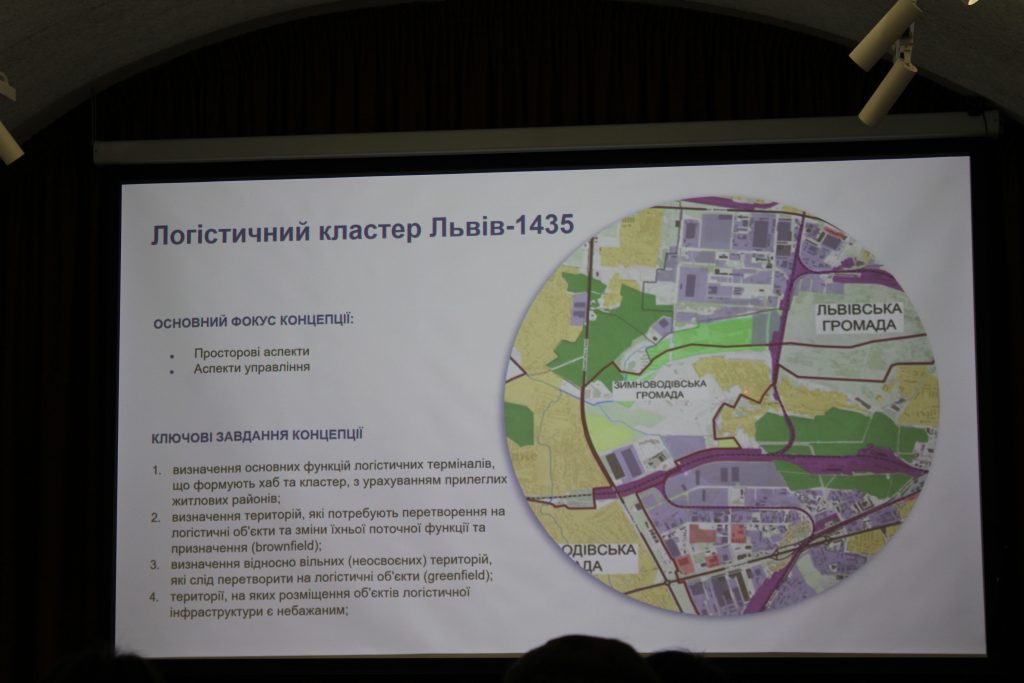
Today, May 29, the official presentation of the results of the large-scale project “Logistics Cluster Lviv-1435” took place at the Lviv “Museum of the City.” The initiative, implemented by the Association with the financial support of the Ukraine-Moldova American Enterprise Fund (UMAEF), brought together representatives of local self-government bodies from the agglomeration’s communities, leading transport experts, and urban planners.
The primary focus of the study was an analysis of the potential of the “Sknyliv-Liski” container terminal, located adjacent to the Sknyliv railway station, as a strategic logistics hub. The key advantage of this location is the opportunity to effectively utilize the European-standard track gauge (1435 mm) to optimize cargo flows between Ukraine and EU countries.
As a reminder, this study aligns with the strategic goal of COMPETITIVENESS within the Lviv Agglomeration Development Strategy until 2027, approved by the Lviv Regional Military Administration.


The presentation began with welcoming remarks from the project’s leaders and partners, who outlined the global significance of the future cluster for the regional economy.
- Roman Kizyma, Executive Director of the Lviv Agglomeration Association, emphasized that this project is a prime example of synergy and inter-municipal cooperation, as the development of a powerful logistics hub will drive economic growth not only for Lviv but also for all surrounding communities within the agglomeratio.
- Iryna Ozymok, Local Economic Development Program Director at the Ukraine-Moldova American Enterprise Fund (UMAEF), noted the high quality of the analytical work and stressed that investments in infrastructure planning bring Ukrainian communities closer to European standards.
- Liubomyr Zubach, Deputy Mayor of Lviv for Urban Development, drew attention to the spatial aspect of the project, stating that the proper integration of the railway hub will relieve traffic on motorways and create a new point of attraction for business.



Technical Developments and Spatial Solutions:
In the practical part of the event, the project developers presented detailed urban planning and transport models for the development of the area around Sknyliv station.
Ihor Mohyla, transport expert at Egis, Rostyslav Bilinskyi, Head of the LKP “Institute of Spatial Development,” and Urs Thomann, a Swiss urban planner and external expert, presented the concept of the cluster’s formation. The specialists described in detail how the 1435 mm gauge infrastructure can be integrated into the existing network, what technological solutions are required for rapid container transshipment, and how to organize the internal logistics of the “Sknyliv-Liski” terminal to minimize the impact on passenger transportation and the environment.
Prospects:
The economic rationale for the initiative was presented by Oksana Zatvorytska, Director of Egis in Ukraine. The presented analysis demonstrated clear benefits for the region. According to expert estimates, the creation of a logistics cluster based on the European gauge will ensure:
- A significant reduction in delivery time and costs for cargo transported to European Union countries;
- The creation of hundreds of new jobs in related sectors (service, customs clearance, distribution, freight villages/logistics centers);
- Additional revenues for the budgets of the Lviv Agglomeration communities by attracting investment and registering new enterprises.

The event concluded with a lively Q&A session. Participants joining both in the hall and via online broadcast actively discussed the practical stages of implementing the developed concept, attracting private investment, and coordinating actions among the railway, state authorities, and local self-government.
The presented study has laid a solid foundation for transforming the Lviv Agglomeration into a leading logistics hub in Eastern Europe, ready for full integration into the Trans-European Transport Network (TEN-T).
The Lviv Agglomeration Association expresses its sincere gratitude to the Ukraine-Moldova American Enterprise Fund (UMAEF) for its strategic support and financing of this study. Thanks to your trust and contribution to the development of local economic potential, our agglomeration’s communities have received a clear, scientifically grounded roadmap for integration into the European logistics space and for strengthening the economic resilience of the region.