
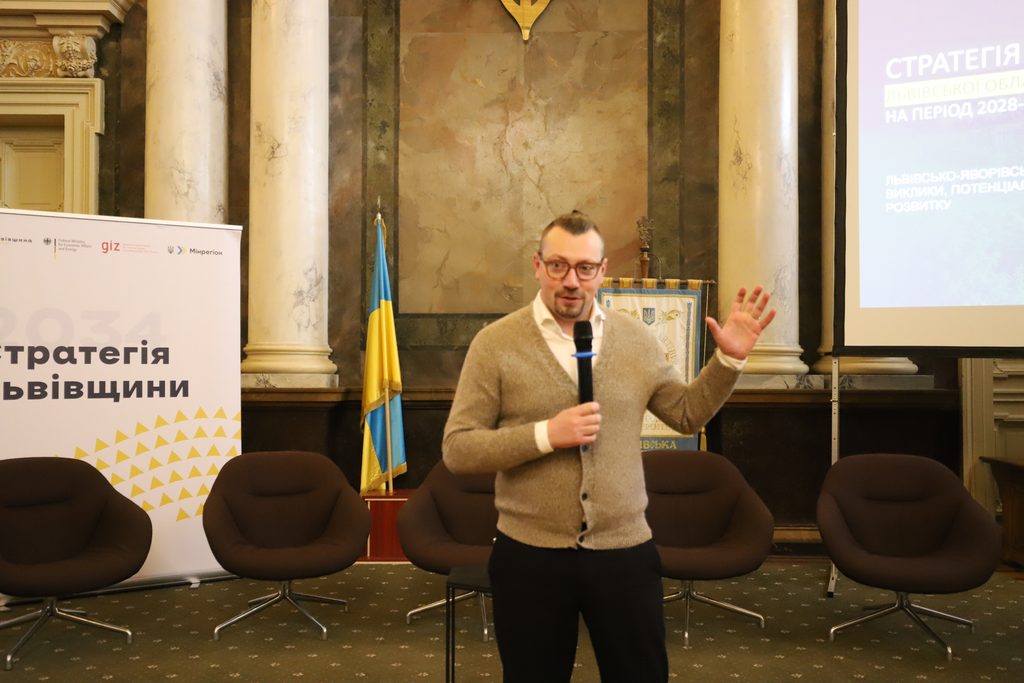
On November 25, Lviv Polytechnic National University hosted an expert discussion titled “The Lviv–Yavoriv Microregion: Challenges, Potential, and Development Priorities.” The event marked one of the key milestones in drafting the Lviv Oblast Development Strategy for 2028–2034, making Lviv Oblast the first region in Ukraine to launch work on this strategic framework.
The discussion brought together Vitalii Bezghin, Minister for Communities, Territories, and Internally Displaced Persons of Ukraine; Andrii Hodyk, First Deputy Head of the Lviv Regional State Administration (RSA); heads of district state administrations; as well as representatives of local self-government bodies, the business community, and the expert sector. The event was organized by the Lviv RSA with the support of the Power4Just Transition project, implemented by GIZ on behalf of the German Federal Ministry for Economic Affairs and Energy (BMWE).
One of the central topics of the discussion was the institutional role of agglomerations in future regional development. Vitalii Bezghin emphasized that major cities naturally attract capital, education, and human resources, noting that around ten agglomerations—including the Lviv Agglomeration—have already organically emerged across Ukraine. However, the national level still lacks the legislative instruments required to regulate their cooperation.
According to the Minister, the state is already working to bridge this gap by preparing a pilot project on joint community planning alongside a corresponding legislative framework. Initial practical steps are already underway: the relevant Verkhovna Rada committee has recommended a draft law on inter-municipal public transport connections for its first reading—a measure critical to the daily functioning of the Lviv Agglomeration.
At the same time, by leveraging its proximity to the EU and the momentum of business relocation, Lviv Oblast is well-positioned to solidify its status as Ukraine’s key economic and infrastructure rear hub.


The Lviv–Yavoriv microregion encompasses 29 territorial communities (across the Lviv and Yavoriv districts) with a combined population of approximately 1.36 million residents. The area accounts for 72% of the region’s active enterprises and two-thirds of its capital and foreign direct investments. However, economic activity remains heavily imbalanced:
- 74% of the microregion’s business entities are registered within the Lviv Territorial Community;
- 77% of the employed population works in Lviv;
- 80% of the microregion’s tax revenues are generated by the regional capital;
- 19 out of 29 communities have a fiscal capacity index below 1.0.
While suburban communities are experiencing rapid growth, more remote areas face depopulation. First Deputy Head of the Lviv RSA Andrii Hodyk stressed that the primary objective of the new Strategy is to turn the economic strength of the urban core into a growth driver for neighboring communities.
Participants identified three key pillars that will underpin the territory’s spatial and economic planning:
- Development of the Lviv Agglomeration. Establishing a unified labor market, integrating public transit and utility networks, coordinating spatial planning, and deepening inter-municipal cooperation.
- Transformation of the Yavoriv Borderland. Leveraging geographic proximity to the EU to build industrial and logistics hubs, turning border communities into self-sustaining centers of economic growth.
- Strategic Infrastructure and Logistics. Modernizing the road network, expanding European-gauge rail tracks (1,435 mm), freight terminals, and suburban rail services, as well as upgrading energy and engineering infrastructure.
The outcomes of the expert meeting will form the foundation for the draft 2028–2034 Lviv Oblast Development Strategy. Incorporating the interests of the Lviv Agglomeration into the region’s core planning document will enable communities to coordinate joint infrastructure projects more effectively and attract investment for the balanced development of the entire territory.





Photo courtesy of the Lviv Regional Council Press Service.